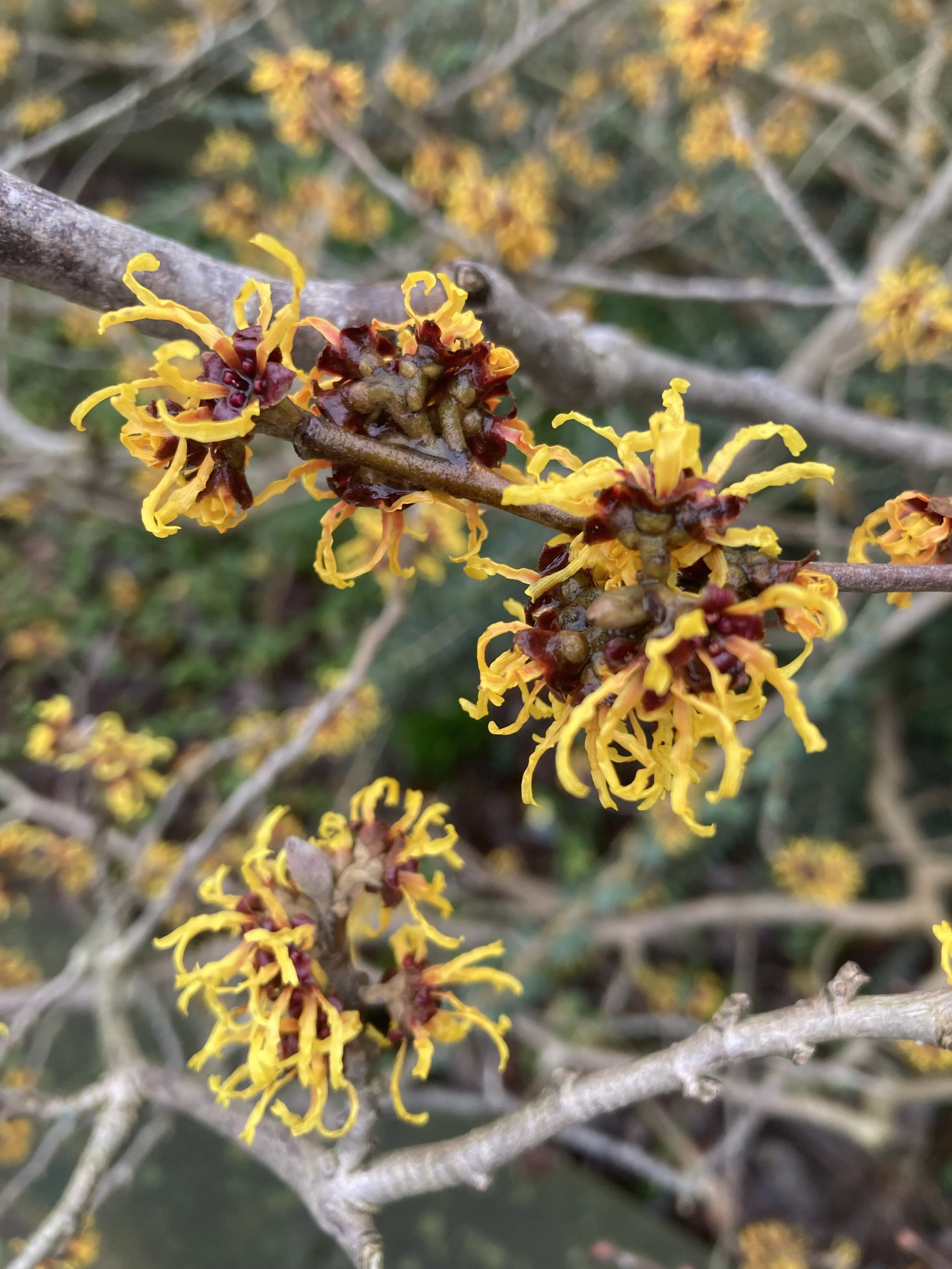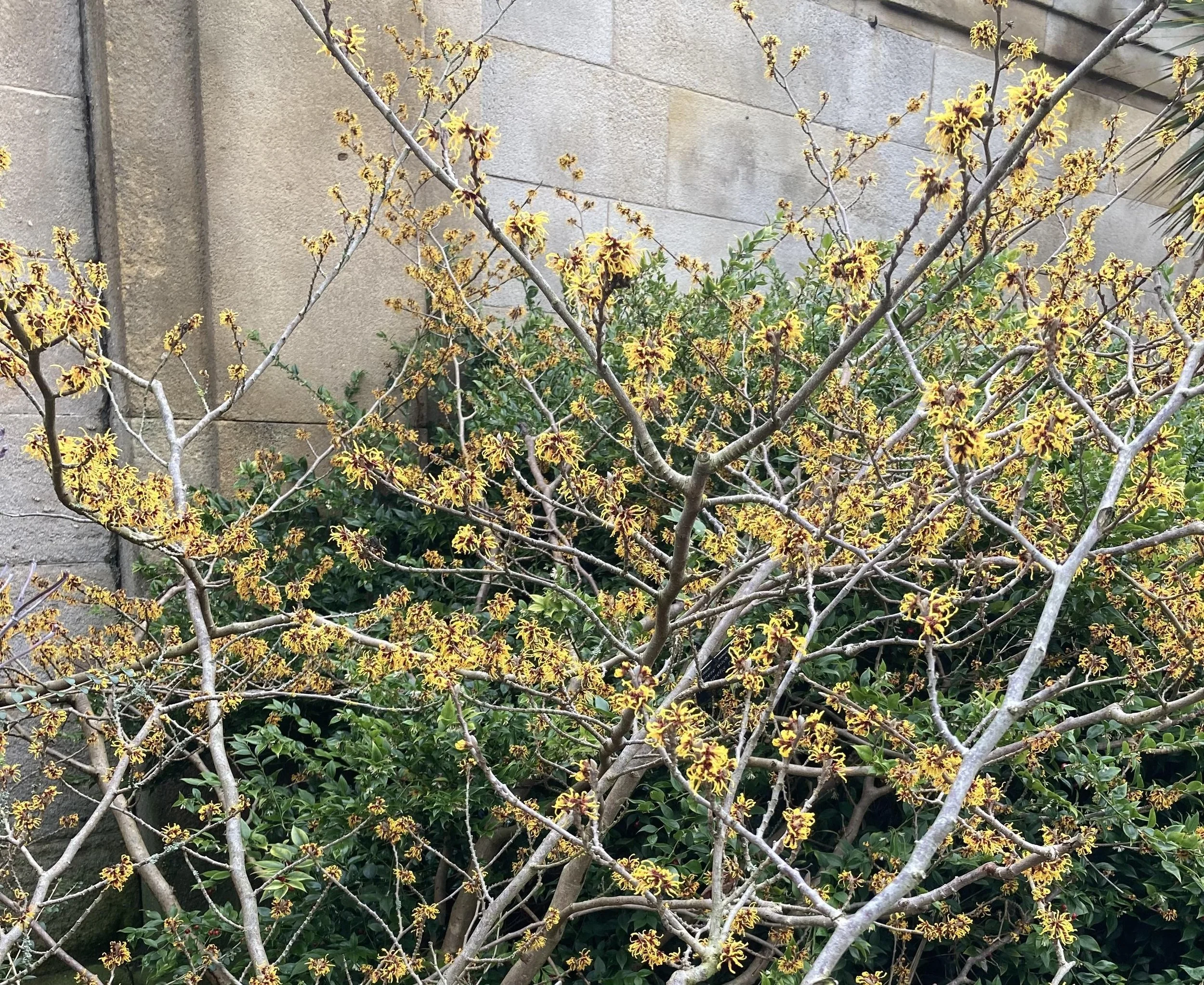
Hamamelis mollis
Hamamelis mollis - Chinese Witch Hazel
This stunning little tree greets visitors arriving at the Main Entrance on Clarkehouse Road; others should pop through the archway to admire it, a cheering sight on a wintry day. The golden-yellow curled petals are held in maroon-red calyces, in clusters of tassels all over the bare twigs. They are not damaged by frost or snow but the scent is only enjoyed at warmer temperatures. (However the gorgeous perfume of the adjacent Sarcococca pervades the air no matter how cold it is.)
This shapely shrub is also good looking in summer with large, soft hazel-like leaves which turn yellow in autumn. (The hazels are in the same family, the Hamamelidaceae.) H. mollis is considered the finest of the species. A number of other forms can be seen in flower in the Woodland Garden (Area Q on the downloadable map) as well as H. virginiana which flowers in autumn and is the source of medicinal witch hazel.
French Plant hunter Augustus Henry described H. mollis in 1888, though Charles Maries had found it in 1879 in Jiangxi Province and sent seed to his employers Messrs Veitch. Only one plant grew but remained unrecognised until noticed by Kew director George Nicholson 20 years later in the Veitch Coombe Wood nurseries. It was soon widely propagated and gained the RHS Award of Garden Merit in 1922.