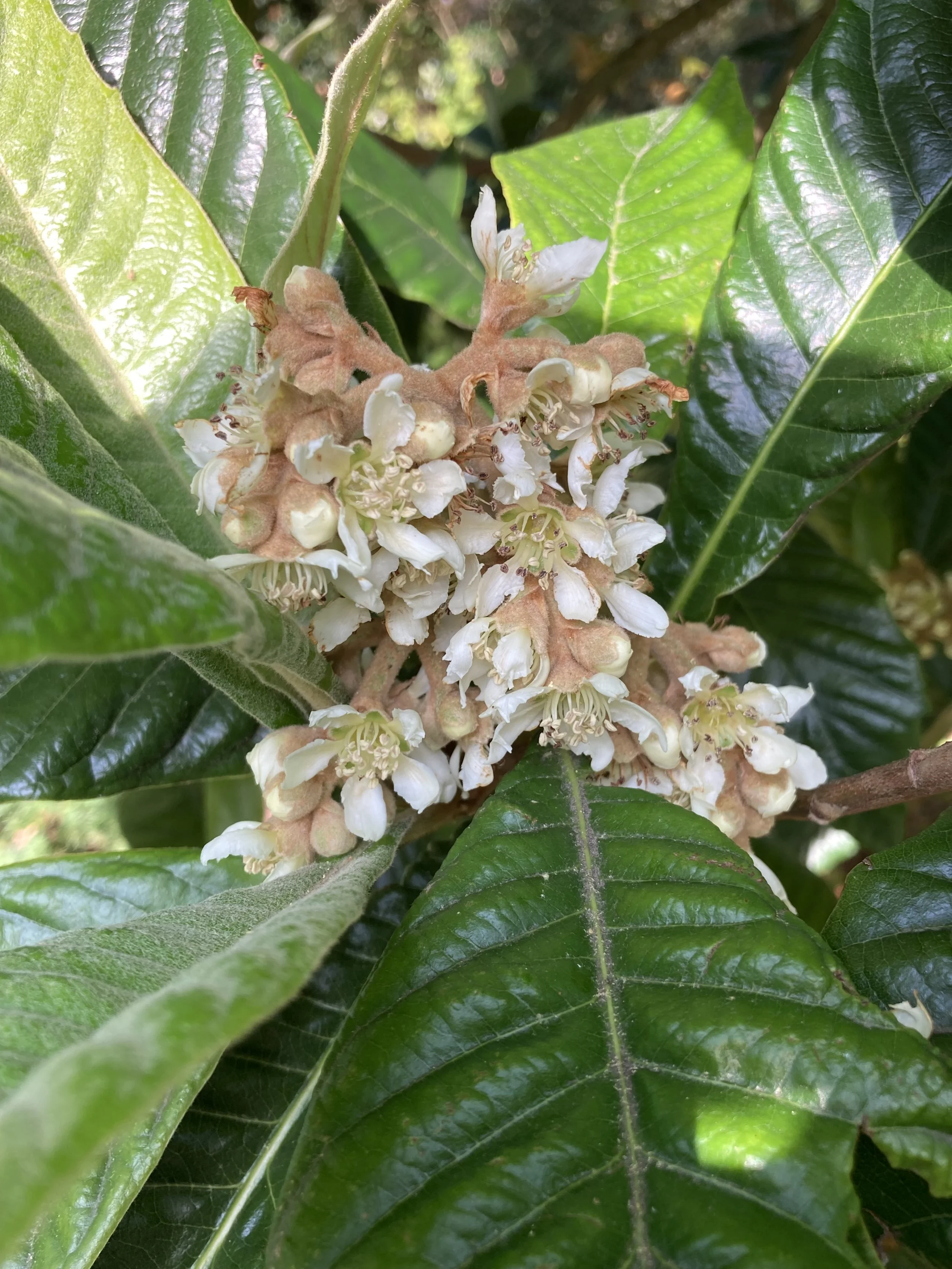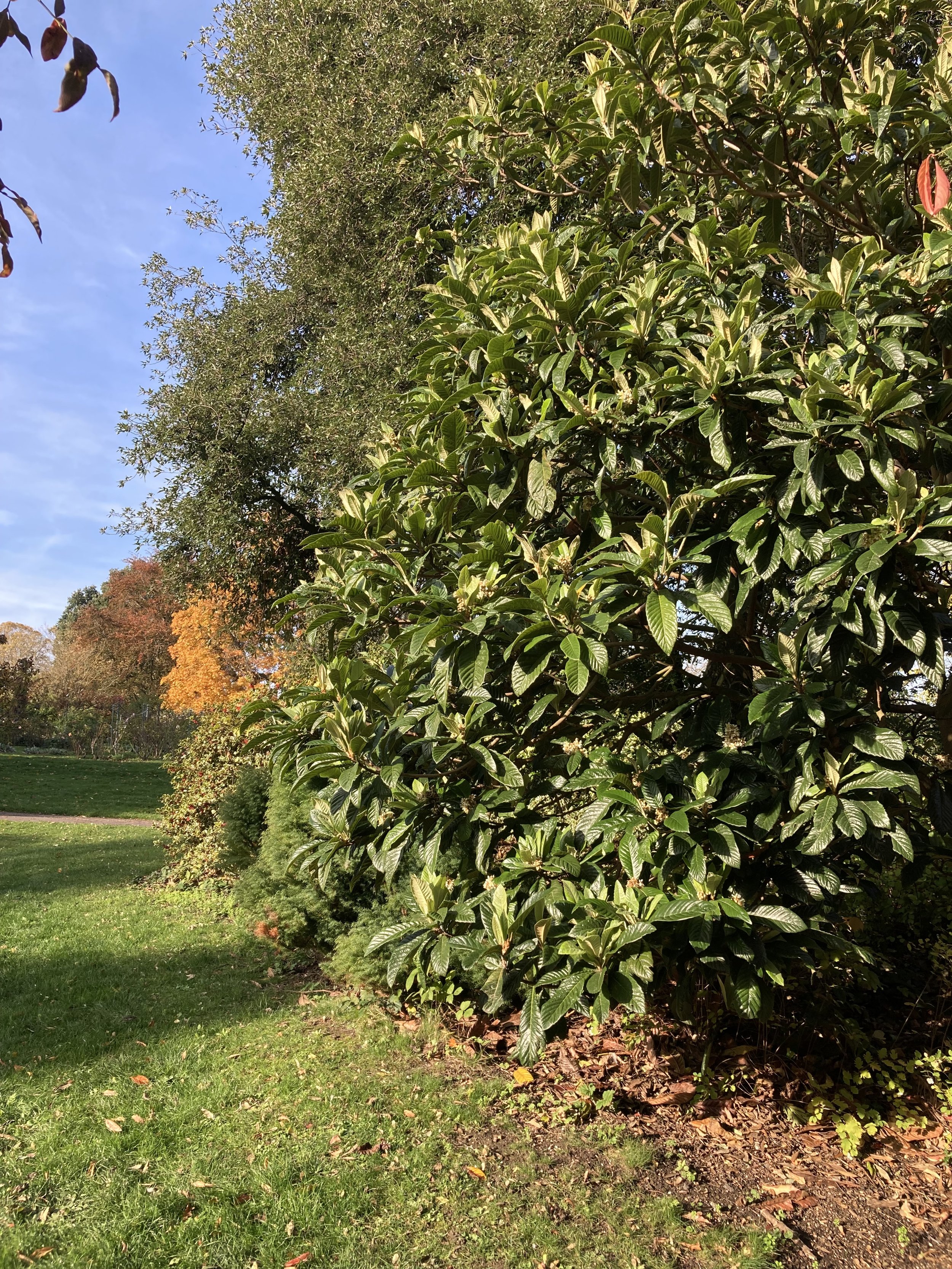
Almost certainly, the profuse flowering of Eriobotrya japonica is one of the many interesting effects of the long hot summer, though unlike the plants which are flowering out of season, this is its natural flowering time. Until recent years it was rare to see any flowers here. In the Rosaceae (rose) family, this highly ornamental shrub is grown for its handsome glossy, deeply veined leaves, at about 20cm long the largest of any evergreen grown outside in the UK, and valued for its architectural presence.
Although frost hardy, it does best in sun in a rather sheltered spot, in well-drained soil of any type. It is drought tolerant. The flowers, fragrant when warmed by the sun, are in closely packed panicles, each with 5 white petals and brownish hairs covering stalks and calyx. They are hermaphrodite and a rich source of nectar and pollen for bees and other pollinators.
The succulent fruits, loquats, up to 5cm long, grow in clusters and are sometimes produced in London gardens and Cornwall. As a commercial crop, 90% of production is from the plant’s native China, though it’s very widely grown in mild temperate climates, often as cultivars. Seed sown plants are prone to the fungal disease, apple scab, but those grafted on a quince (Cydonia vulgaris) rootstock are very resistant to this.
Eriobotrya japonica was introduced to Kew by Sir Joseph Banks in 1787 from South East China. Although Chinese, the species name suggests Japanese origins and it has grown in Japan for 1,000 years! The genus name comes from the Greek for ‘wool’ - ‘erion’ (referring to the pubescence coating young leaves and buds) and ‘botrus’ meaning ‘bunch of grapes’.
In SBG the shrub is to be found in the bed across the path at the top of the Evolution Garden and below the Rose Garden.
RHS recommended: Award of Garden Merit 1993.