Salvia uliginosa
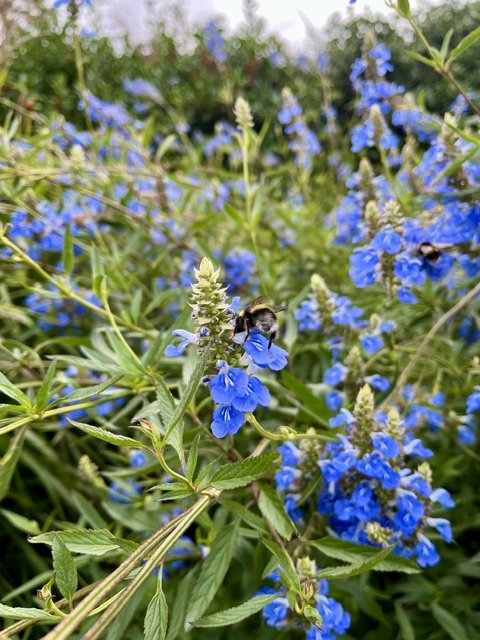
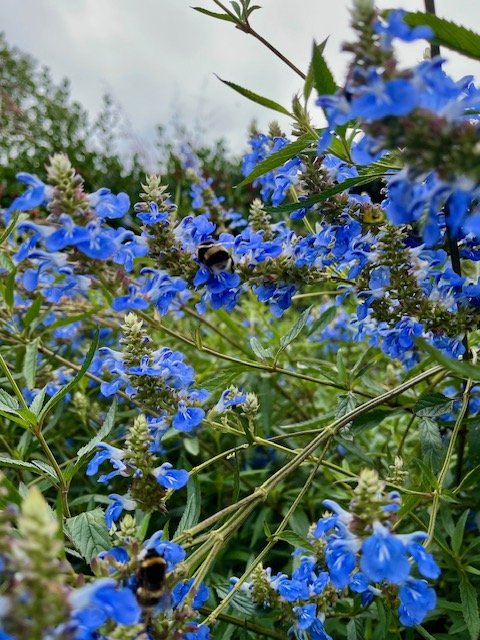
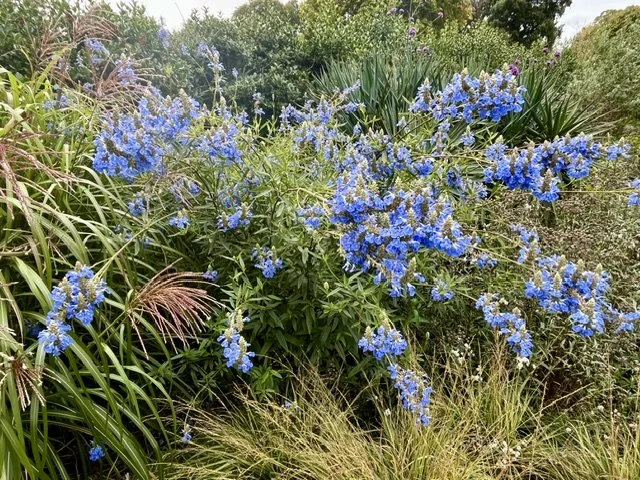
As you walk towards the Pavilions from the fountain end of the Broadwalk you cannot fail to notice on the left, Salvia uliginosa or ‘Bog sage’ with its electric clear sky-blue flowers.
This is a robust, clump forming herbaceous perennial, preferring a south facing sheltered and sunny site with a reasonably rich moist soil, of which it would have traditionally been said, should not dry out in summer, however, it has survived this summer very well.
It flowers freely on branching and often naked stems, as the narrow-toothed leaves become less abundant towards the tip of the stem. The stems themselves are square which is a characteristic of many plants in the Mint family, Lamiaceae, of which Salvia uliginosa is a member. Flowering starts in late summer, and it will continue to produce those intense, pale blue flowers until the first frost. The flowers are bee and pollinator favourites.
Hardy to -5C -10C it is recommended in colder areas that a mulch is applied before winter sets in, this will help protect the crown until spring.
Propagation is reasonably straightforward by basal or softwood cuttings in spring or early summer, or semi-hardwood cuttings in late summer or autumn with bottom heat.
Salvia uliginosa had previously been awarded the RHS Award of Garden Merit and this was reaffirmed following RHS Salvia hardy trials 2022-24 when the RHS also renamed the RHS AGM as the RHS Recommended: Award of Garden Merit.
There is a slightly smaller compact cultivar to a height of around 1m available, Salvia uliginosa ‘Ballon Azul’ with yellow green leaves is an introduction from the Ewald Hugin Nursery in Freiburg, Germany.
Salvia uliginosa is native to damp grasslands and watercourses in South East and Southern Brazil, Northern Argentina and Uruguay, a primarily sub-tropical biome with hot and humid summers and mild, cool winters, with occasional light frosts, hence the recommendation for mulching. Being adapted to this climate also helps explain its naturalisation designated in 1978 in North Island New Zealand.
The plant was introduced into British horticulture in 1912, but first described by the celebrated English botanist George Bentham (1800-1884) as part of his seminal work Labiatarum Genera et Species (1832-1836), the first significant scientific treatment of the Salvia genus.