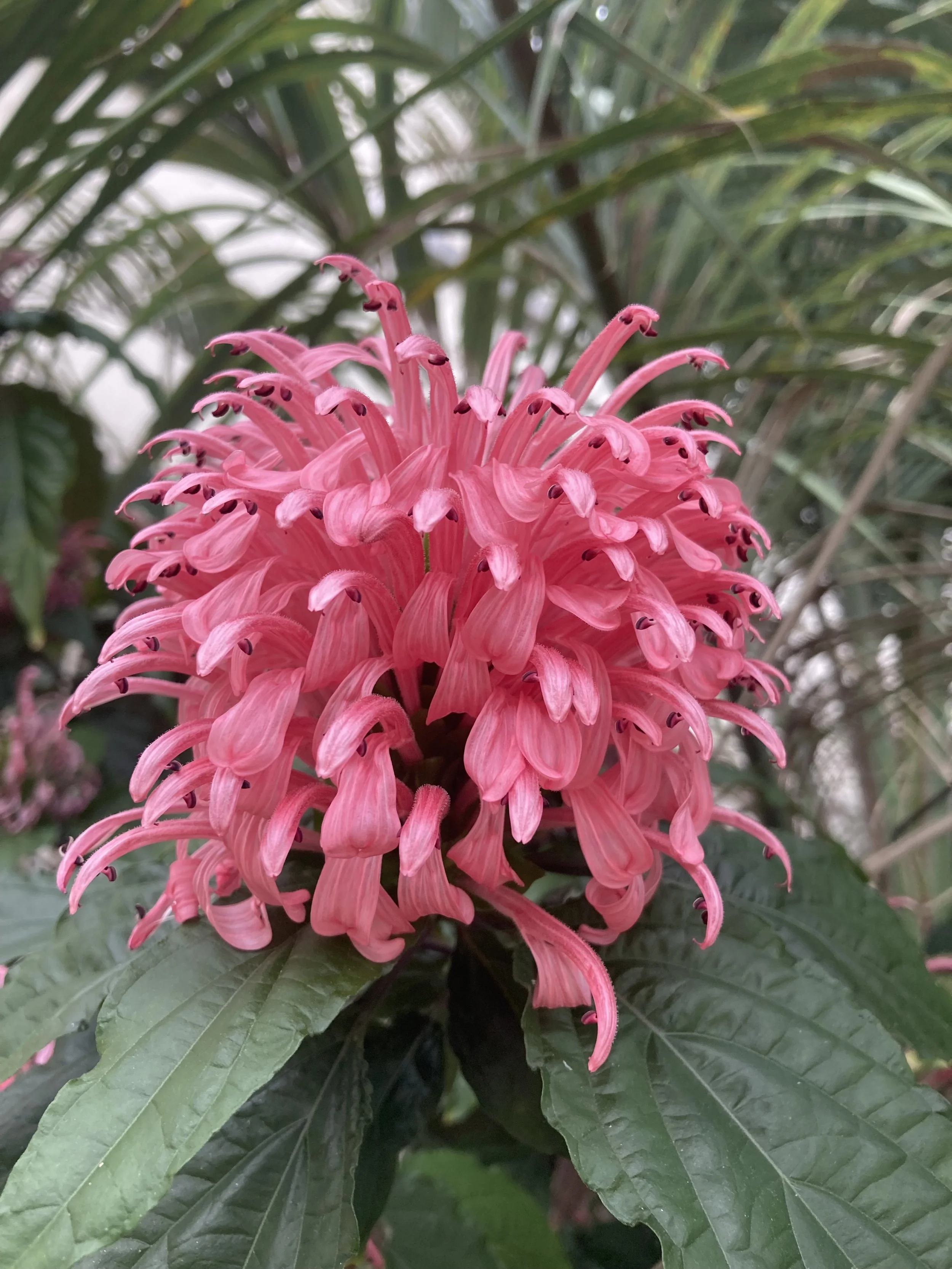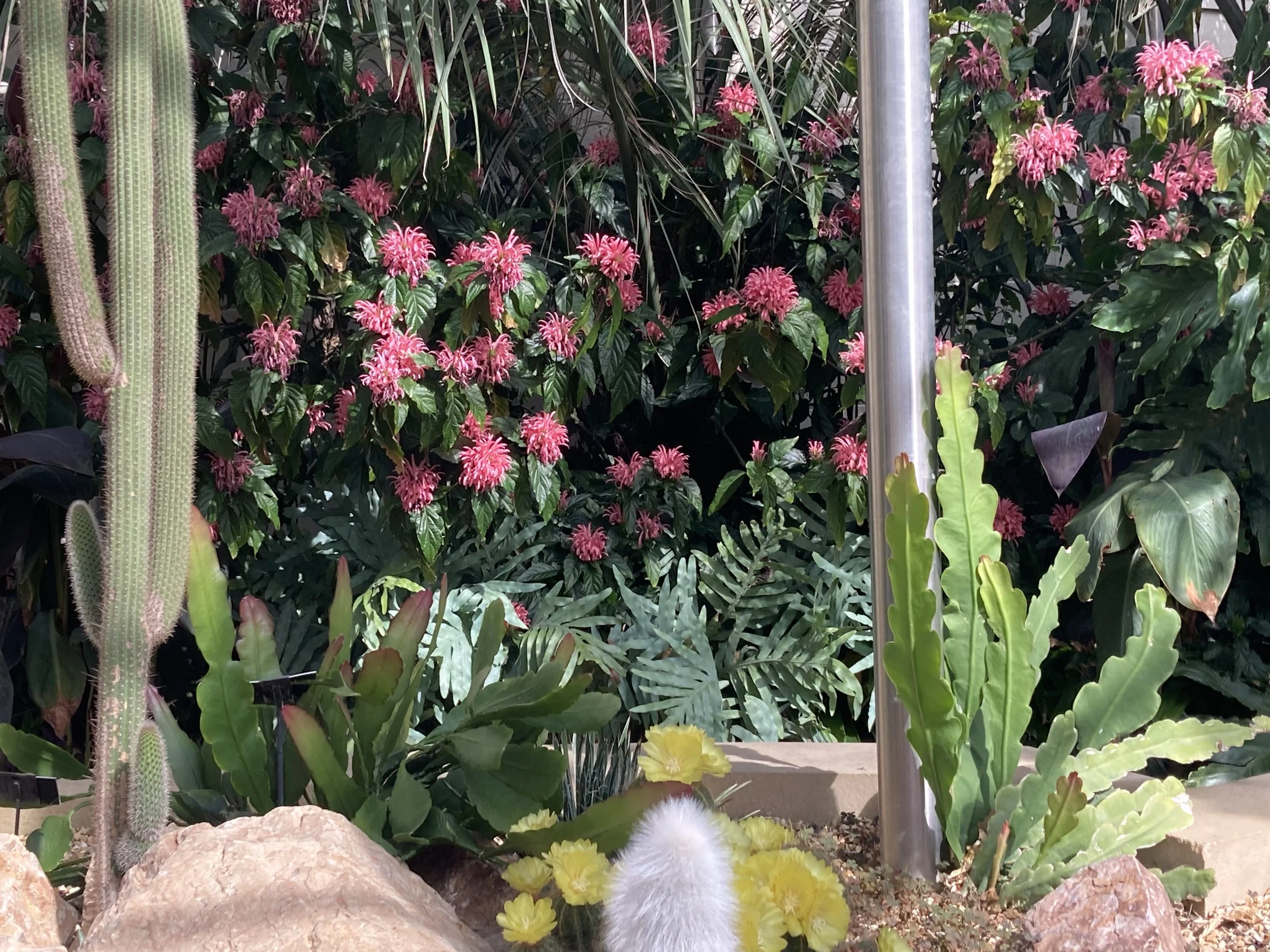
Justicia carnea
Brazilian plume flower
This is sometimes seen as a houseplant, but not often as a magnificent showy specimen shrub as here in the Pavilion’s West Ridge and Furrow section. This is in full sun, though J. carnea is tolerant of very shady situations. Its plumes of pink tubular flowers contrast well with the evergreen, dark leaves which are deeply veined and purple on the underside.
It is in the Acanthaceae family and is one of over 400 species comprising perennials, shrubs and sub-shrubs, mostly from the tropics. J. carnea is from parts of Argentina, parts of Brazil, and Paraguay. It has long been cultivated in Africa and in Nigeria in particular much used in medicine. When boiled, the plant’s leaves produce a crimson liquid, a tea, which is widely used to treat blood disorders, boost energy and aid recovery from illness. As well as minerals and vitamins, it is rich in phytochemicals with their antioxidant properties, and research has shown that many health benefits derive from it. Among the nicknames of the medicine are ‘blood of Jesus’ and ‘hospital too far’.
James Justice was a key pioneering amateur gardener who first propagated pineapples in Scotland in 1728. He later published ‘The Scots Gardener’s Director’, instructing on the cultivation of new exotic species in northern conditions, using his innovative methods with hotbeds and heated walls. In honour of him, Linnaeus named the genus Justicia in 1753.
The yellow flowered cactus in the foreground of the cactus bed is Parodia magnifica